NON-SURGICAL CARE
Joint injections
in Toronto.
Explore ultrasound-guided PRP, nSTRIDE, Arthrosamid and hyaluronic acid injections with Dr. Jihad Abouali in Toronto. Your diagnosis and goals guide a treatment plan tailored to your condition.
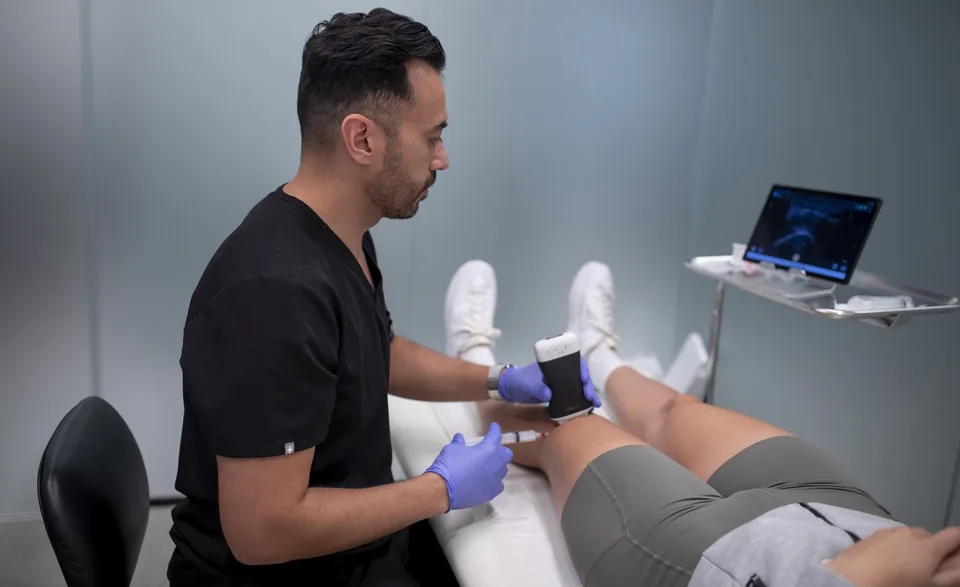
A considered approach
to joint pain.
Dr. Abouali offers ultrasound-guided injections alongside assessment and rehabilitation planning. Your diagnosis and treatment goals help determine which options to discuss.
Discuss your optionsPUBLISHED EXPERTISE · CANADIAN PRIMARY CARE TODAY
A leading voice in regenerative medicine.
Dr. Abouali brings his clinical experience and research-informed perspective to the evolving field of regenerative medicine. In a published article for Canadian Primary Care Today, he discusses platelet-rich plasma (PRP) and examines nSTRIDE, an autologous protein solution, in the context of treatment options for knee osteoarthritis and their implications for clinical practice.
Read Dr. Abouali’s articleTREATMENT OPTIONS
Compare PRP, nSTRIDE, Arthrosamid and hyaluronic acid.

Platelet-rich plasma (PRP)
A sample of your blood is processed to concentrate platelets, which release growth factors involved in healing. PRP can be used for selected tendon, ligament and joint conditions to support the body's natural healing response. It may encourage tissue repair and remodeling, with the aim of improving tissue quality, symptoms and function. Regeneration of damaged tissue is being studied and cannot be promised. For knee osteoarthritis, some studies report symptom improvement lasting around 6–12 months; results for other injuries and individual patients vary.

nSTRIDE
Designed specifically for knee osteoarthritis, nSTRIDE processes your own blood to concentrate proteins that may counter inflammatory signals in the joint. It is given as a single injection. Symptom relief may last 1–3 years in some patients; three-year follow-up has been reported, although studies have had mixed results.

Arthrosamid
Arthrosamid is a polyacrylamide hydrogel injection for knee osteoarthritis that became available in Canada relatively recently. Dr. Abouali was among the early Canadian clinicians to adopt this treatment and has developed substantial experience assessing who may benefit and how to administer it. The gel integrates with the joint lining and may help reduce pain and improve function. Some patients in follow-up studies have reported benefits at 4–5 years after one injection. The duration of relief is not guaranteed.

Hyaluronic acid
Hyaluronic acid is a component of normal joint fluid. Injecting it into an osteoarthritic joint aims to improve lubrication and reduce painful friction. When it helps, relief often lasts about six months, though the response varies by person and product.
Conceptual illustrations of treatment materials and joint structures; they do not depict a patient outcome.
These timeframes describe possible symptom relief, not permanent repair of arthritis. Suitability, expected benefit, risks and costs are discussed at your assessment. A treatment plan may also include physiotherapy, activity changes or bracing.
Read the research: PRP overview · nSTRIDE follow-up · nSTRIDE controlled trial · Arthrosamid follow-up · Hyaluronic acid review
PLANNING YOUR TREATMENT
Questions about injections.
Which injection is right for my condition?
Your diagnosis, symptoms, previous treatments and goals help guide the choice. PRP can be discussed for selected tendon, ligament and joint conditions; nSTRIDE and Arthrosamid may be discussed for joint osteoarthritis, with suitability depending on the affected joint and individual assessment, including whether the proposed use is off-label. Review the treatment descriptions above and ask about expected benefits, risks and alternatives at your assessment.
How much do injections cost?
Fees depend on the treatment and your plan. Contact the office for current pricing and ask your insurer about any extended health coverage before treatment.
Where can I arrange an assessment?
Contact Dr. Abouali’s office at 481 Danforth Avenue in Toronto, or call 416-546-7373. The team can explain the consultation and referral process.
Explore Dr. Abouali’s clinical experience and publications, or ask about an injection consultation.